

Organize equipment around on-site processing
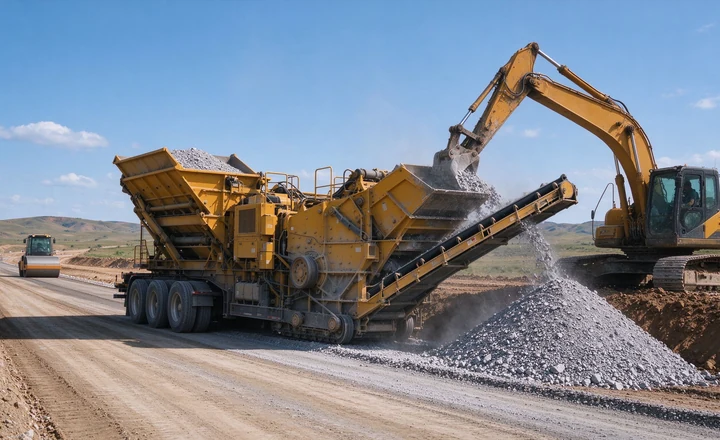
Moving all construction waste off site adds vehicle coordination and material-handling stages. Processing suitable waste where it arises may reduce some material awaiting transport and support the separate use of recycled aggregates. The value of a mobile plant depends on incoming material, working space and the destination of the products. The machine does not replace site sorting management or quality checks.
Select the crusher and power arrangement for the duty
The RP-MC-100 offers jaw or impact crusher configurations and diesel or electric drive options. Evaluate a jaw configuration for primary hard-rock crushing, and an impact configuration for medium-hard materials and suitable recycled feed. Power selection should reflect local energy availability, operating arrangements and maintenance conditions. These options do not mean that every machine includes all crusher types or automatic switching between two power sources; define the supply scope when purchasing.
Read preliminary specifications in their configuration context
The supplied data lists plant capacity at 100–200 t/h, maximum feed size at 500 mm, total power at approximately 220 kW and weight at approximately 35 t. These figures support preliminary discussion. Final feed limits, power and weight depend on the selected crusher and modules. Actual throughput also depends on material composition, continuous feeding and screening conditions, and should be assessed against the required products.
Prepare the site before mobile deployment
The wheeled platform supports relocation to suit project schedules, but positioning, support, power connection and commissioning are still required after arrival. Check road access, ground bearing capacity, operating clearances and transport permits in advance. Remove metal, timber and other contaminants before processing construction waste. Whether recycled aggregate can be used in a particular application depends on local requirements and relevant test results.
Compare layouts using the complete operating cost
Compare mobile and fixed processing arrangements using material travel distance, energy supply, available project time and relocation requirements. Extensive secondary handling after on-site processing may reduce the benefit of a mobile layout. First sketch the incoming-material area, operating area and product storage positions, check for conflicting vehicle movements, and then discuss machine orientation and conveyor configuration to match site operations.
Start purchasing discussions with application inputs
The minimum order is one unit. The supplied lead time is 45–60 days, with production and shipping dates subject to the agreed order. RockPeak can provide installation drawings, operating instructions and remote technical guidance; site service is arranged per project. State the raw material, feed size, target output, finished sizes and relocation frequency when enquiring so crusher and power options can be compared and the equipment scope defined.
PROCESS FIRST
Discuss your application inputs.
Share your material, feed size, target throughput, finished sizes and project location.